Ischgl today
Updated today, 13:07 CETPistes open0 of 88
Lifts open0 of 46
Temp. top / bottom−2° / 7°
No lifts open
Forecast data:

No lifts open
Forecast data:
Temperature on the mountain and in the valley, wind and fresh snow.
| Day | Today31 Oct | Sun1 Nov | Mon2 Nov | Tue3 Nov | Wed4 Nov | Thu5 Nov | Fri6 Nov |
|---|---|---|---|---|---|---|---|
| Weather | |||||||
| Top, 2,872 m | −2° | −10° | −3° | −3° | −3° | 2° | 1° |
| Valley, 1,360 m | 7° | 1° | 6° | 8° | 8° | 11° | 12° |
| Snow (top) | 0 cm | 1 cm | 0 cm | 0 cm | 0 cm | 0 cm | 0 cm |
| Wind (top), km/h | 21 | 21 | 12 | 9 | 21 | 9 | 7 |
Snow in centimetres, average wind speed on the mountain in km/h. Forecast run 31 Oct, 11:21 CET.
Vertical drop of 1,512 m.
Prices in high season, 26 Nov to 2 May.
| Group | 1 day | 3 days | 6 days |
|---|---|---|---|
| Adultsaged 17 to 64 | €83 | €244 | €451 |
| Youthaged 8 to 16 | €51 | €142 | €257 |
| Seniorsaged 65 and over | €83 | €244 | €406 |
Children born in 2017 or later ski free.
Prices checked 31 Oct 2026
Average snow depth on the mountain, month by month.
Average of 10 seasons, 2016 to 2026
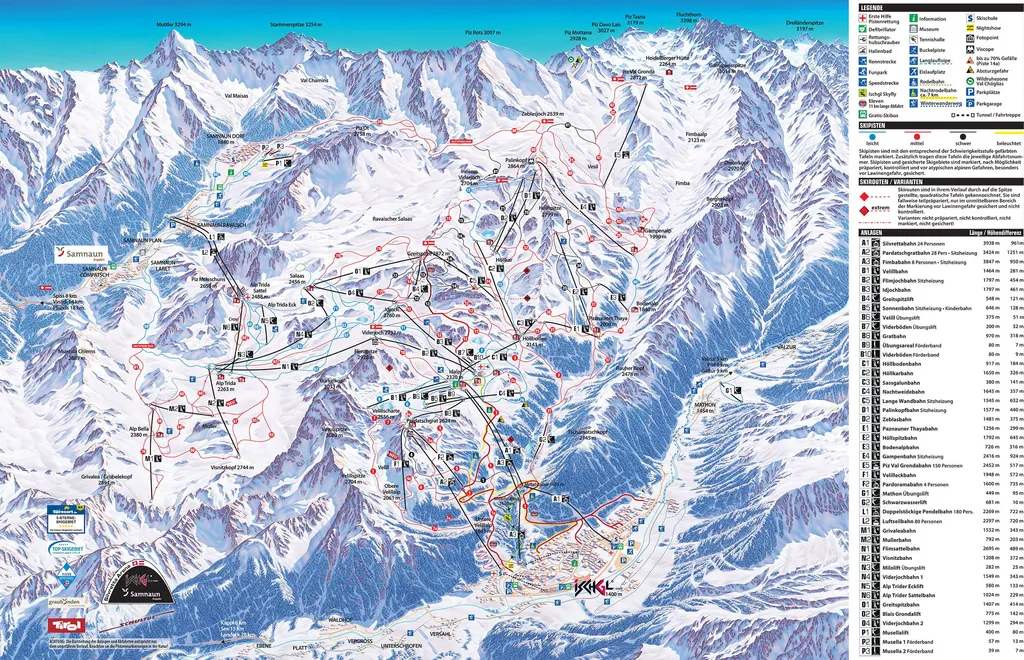
Ischgl lies at 1,400 m in a narrow, funnel-shaped valley surrounded by the Silvretta massif. It is one of the largest ski areas in Austria: the Silvretta Arena, with 239 km of pistes (according to the operator's figures), stretches all the way to Samnaun in Switzerland, which means that in a single day you can ski from Austria to Switzerland and back, stopping off in the duty-free zone on the way. The hub of the whole resort is the Idalp plateau (2,311 m): this is where the top stations of the lifts from Ischgl meet, and every skier ends up here at some point, whatever their ability. Those looking for a challenge head towards the Pardatschgrat and down the black pistes. Those who prefer a calmer pace stay on the wide, sunny slopes around the Idalp itself. The last two seasons have been a time of major infrastructure upgrades for Ischgl. Silvrettaseilbahn AG is investing €50 million in replacing three key chairlifts, Höllboden, Sassgalun and Höllkar, with modern 8-seater chairlifts with weather hoods, heated seats and the autonomous AURO traffic management system, the first of its kind in the whole Silvretta Arena. The old lifts are not going for scrap: the dismantled Höllboden will be rebuilt in the neighbouring resort of See. Even more interesting, if less talked about, is a project on the Swiss side: in Samnaun, construction is starting on a brand-new 10-person Laret gondola, which will link the valley station at Laret/Compatsch with the summit of the Muller. It is the first major investment by Bergbahnen Samnaun AG in years: the Swiss Federal Office of Transport only granted the construction licence in March 2026, and the opening is planned for November 2027. Ischgl has long been about more than just pistes. It was the first major ski resort in the Alps to be certified climate-neutral: most lifts run on power from local hydroelectric plants, the snow cannons work from GPS measurements of snow depth, and more than 10,000 trees have been planted around the valley. It is a rare example of a resort that combines party flair with a real environmental strategy. And there is no shortage of parties. The legendary Top of the Mountain concerts, held at the season opening and closing and at Easter, have drawn international stars to Ischgl for years: last season the performers on the stage at more than 2,300 m included Rita Ora, Robin Schulz, Ben Zucker and Christina Aguilera. The ticket? An ordinary ski pass. After skiing it is worth heading down to Ischgl itself, a small but lively village where the bars and pubs fill up before you have even had time to take off your ski boots. Those looking for a quieter base can consider nearby Pfunds, from where it is just as easy to reach Samnaun-Ischgl as Nauders or Serfaus. Who is Ischgl for? Above all for intermediate and advanced skiers who do not mind crowds in exchange for large-scale infrastructure, and for those for whom the evening after skiing matters as much as the day on the slopes. Families with small children will find good facilities here (kids' areas, childcare), but this is not a resort built around an intimate family atmosphere: it is closer to the energy of a big international resort with ambitions. When to go? Thanks to its high altitude (up to 2,872 m), the season runs practically from late November to early May. The best snow conditions are in January and February, outside the Polish winter school holidays (ferie). If you want to catch a Top of the Mountain concert with good weather and spring snow, aim for April. How to avoid the crowds? Ischgl's record visitor numbers are no accident: it is one of the busiest resorts in the Alps, especially on concert days and during the ferie. It is worth choosing midweek outside public holidays and avoiding the morning rush hour at the Idalp.
70 km of pistes · 1,790 to 2,872 m
214 km of pistes · 1,200 to 2,828 m
75 km of pistes · 1,394 to 2,750 m
70 km of pistes · 1,250 to 2,783 m
In the 2026/27 season a one-day adult pass costs €83 and a six-day pass €451 (prices in high season, 26 Nov to 2 May).
The resort plans to open on 26 November 2026 and to close on 2 May 2027.
The pistes run from 1,360 m to 2,872 m, a vertical drop of 1,512 m.
Ischgl has 239 km of pistes, served by 46 lifts.