COS Skrzyczne today
Fresh snow1 cm · 72 h
Temp. top / bottom0° / 6°
No report
Forecast data:
No report
Forecast data:
Temperature on the mountain and in the valley, wind and fresh snow.
| Day | Today31 Oct | Sun1 Nov | Mon2 Nov | Tue3 Nov | Wed4 Nov | Thu5 Nov | Fri6 Nov |
|---|---|---|---|---|---|---|---|
| Weather | |||||||
| Top, 1,257 m | 0° | −1° | 0° | 0° | 0° | 3° | −1° |
| Valley, 550 m | 6° | 5° | 4° | 3° | 4° | 5° | 2° |
| Snow line | 1,000 m | ||||||
| Snow (top) | 6 cm | 1 cm | 1 cm | 1 cm | 0 cm | 0 cm | 0 cm |
| Wind (top), km/h | 30 | 32 | 30 | 39 | 32 | 14 | 31 |
Snow in centimetres, average wind speed on the mountain in km/h. Forecast run 31 Oct, 11:21 CET.
Vertical drop of 707 m.
Average snow depth on the mountain, month by month.
Average of 10 seasons, 2016 to 2026
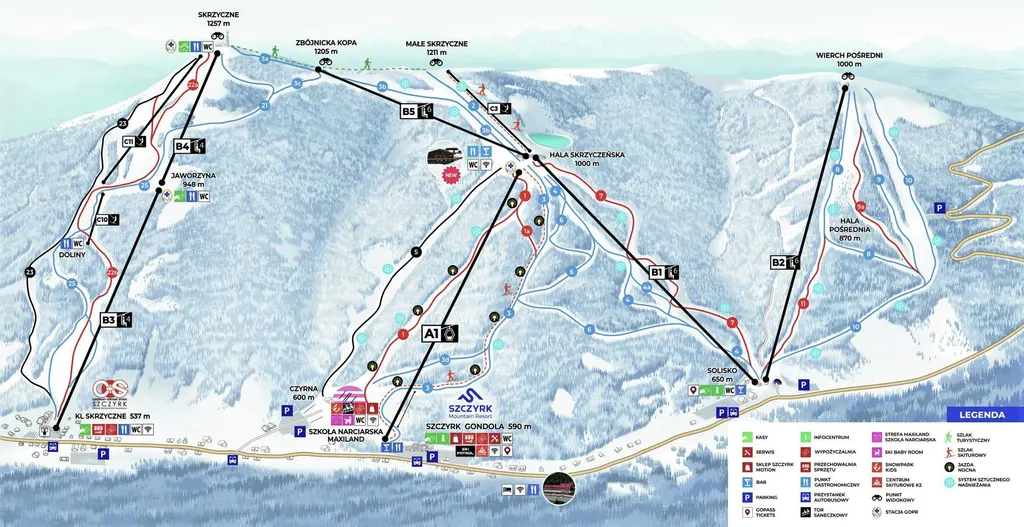
The slopes of Skrzyczne were recognised as excellent skiing terrain even before the war, and this reputation was sealed when the Wintersportklub from Bielsko built a mountain hut below the summit. But the real skiing "career" of the place only began after the war. The first major ski installation was a chairlift built in 1958 (the first in Poland). Soon afterwards, in the 1960s, work began on the slopes of neighbouring Małe Skrzyczne on the Górniczy Ośrodek Narciarski (GON, the Miners' Ski Centre), which kept growing until the 1990s. This is how Szczyrk became the Winter Capital of the Beskids. The chairlift, the main axis of the whole resort, has two sections, with a transfer station at Hala Jaworzyna. The original single chairs of 1958 were replaced in 1993 by slightly more comfortable two-seaters, but this did not raise lift capacity to a satisfactory level. Only in the 2013/14 season did the upper section finally get a proper modern lift: a four-seater chairlift with bubbles, high headrests and individual safety bars for skiers. The ride time fell from 13 to 4 minutes. In 2017 the lower lift was modernised too, with a twin but slightly more modern chairlift, also a four-seater (with bubbles), made by Leitner. In addition the resort has two long T-bars, one in the upper and one in the middle part of the slope. Skrzyczne is a favourite with skiers, especially more advanced ones. No wonder: of the almost 14 km of pistes marked out here, the vast majority, particularly on the upper mountain, offer long, steep and very dynamic runs. The red Kaskada is especially well known, descending in alternating gentle stretches and steep pitches. Even more demanding is the FIS piste, which is said to be more famous even than both runs on Kasprowy. On its upper part the gradient hovers around 30 degrees over a long stretch. Some sections, such as the famous Grzebień, are a challenge for a good skier even when taken in zigzags. It is the only piste in Poland homologated for downhill races. Runs like these have made Skrzyczne a cult mountain for skiers. The facilities are fairly extensive: as the lift starts practically from the town centre, skiers can use the restaurants and bars in town, there is food at Hala Jaworzyna too, and on the summit there is a mountain hut, also with a restaurant (beginners have a nursery slope with a lift next to the hut, which is not part of the COS complex). The drawback and biggest inconvenience is the lack of large enough free car parks at the valley station: the sizeable municipal car park nearby charges a fee. Skrzyczne is without doubt one of the most interesting ski areas in Poland, good above all for advanced skiers, but further modernisation is essential if it is to match the standards of other large ski resorts in Poland.
37 km of pistes · 618 to 1,250 m
12 km of pistes · 708 to 1,471 m
13 km of pistes · 639 to 1,050 m
1 km of pistes
The pistes run from 550 m to 1,257 m, a vertical drop of 707 m.
COS Skrzyczne has 12 km of pistes, served by 6 lifts.